

UK charities have reported declining web traffic as readers get information from AI-generated answers rather than trusted expert sources.
Health charities have been particularly hard hit as patients seeking information about their conditions are presented with extensive AI-written summaries that push links to websites far down search engine results pages.
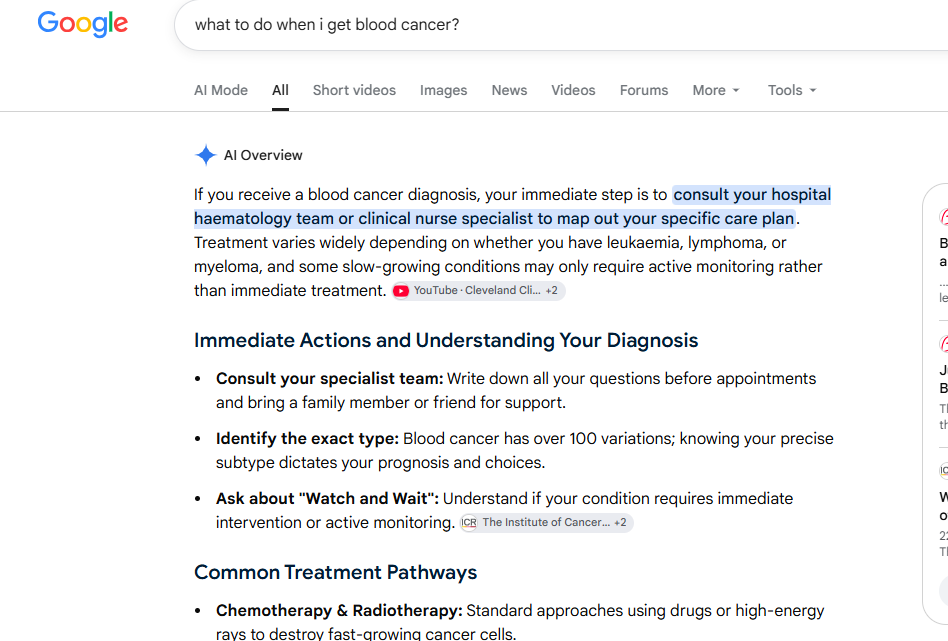
A Google search for the term “what to do when I get blood cancer” now generates a detailed 270-word AI-generated summary, which includes the disclaimer “AI generated responses may include mistakes”. Much of the information is taken from the website Blood Cancer UK whose main link is now buried far below the scroll.
Cancer UK, Mind, the Mental Health Foundation, The Brain Tumour Charity and Save the Children all also told Press Gazette their website traffic has fallen significantly over the past 12 months in the wake of the rollout of Google AI Overviews.
Kate Keightley, associate director at Blood Cancer UK, said: “Visits to some of our disease-specific information have fallen, while engagement within the same period in our online community has grown.
“What is particularly interesting is the growing appetite for lived experience. While AI can provide an instant summary, it can’t replace the reassurance and understanding that can come from speaking to somebody who has been through something similar.”
She added: “People searching for information about leukaemia, lymphoma or myeloma may be newly diagnosed, worried about symptoms or trying to understand treatment for someone they love. It’s vital that whatever route they take to find answers leads them to information that is accurate, trusted and appropriate to their circumstances.”
Keightley reported that views have gone down 53% on their leukaemia page, 45% on their MGUS page, 32% on their myeloma page, 28% on their lymphoma page, 20% on their AML and MDS pages and 17% on their MPN page. However, page views on their general blood cancer information hub have remained comparatively stable.
She said: “This suggests the decline is concentrated in exactly the kind of narrow, factual searches AI Overviews are built to answer directly, rather than reflecting a broader loss of interest in our health information as a whole.”
Over the same period, page views on the Blood Cancer UK online community forum, where people affected by blood cancer can connect and support one another, have increased by 86% and the average rate of engagement which has increased by 143%.
Mental health charity Mind has conducted research showing that 60% of people are now turning to chatbots for mental health support.
The charity said: “This suggests that while people are increasingly turning to AI to support their mental health, it is not always seen as a like-for-like replacement for human-centred care.”
Lee Batchelor, head of marketing and content at the Mental Health Foundation, said: “If someone finds trusted, evidence-based mental health information that helps them, even without visiting our website, that’s still a positive outcome and very much part of our mission.”
Batchelor added: “What’s interesting is that the people who do come to our website often seem to arrive with a clearer purpose, whether they’re looking for support, helping a loved one or choosing to donate.”
Yet Russ Peach, website officer for The Brain Tumour Charity, said “donations have remained fairly constant because we are mostly seeing the traffic fall-off affecting our organically-served support and information pages instead of our campaign-driven fundraising efforts.” This is despite “a drop in web traffic of approximately 27%”.
Save the Children is directly focusing on maximising visibility in AI answers.
Ruby Harrison-Stock, senior digital experience manager at Save the Children, said: “AI Overviews and tools like ChatGPT have fundamentally changed search behaviour, and our own data reflects that shift. Clicks and impressions on our site were down year-on-year in July, in line with an industry-wide trend that’s seen up to 60% of searches end without a click. But we don’t think it’s possible to isolate ‘AI impact’ as a single cause of any traffic decline, since search behaviour, algorithm changes and platform shifts are all moving at once.
“What’s notable is that this decline is happening at the same time that our AI visibility is growing strongly. Our AI overviews increased by 303% compared with July last year, and we remain the most-mentioned and most-cited charity brand in AI search across the topics we track.
“That suggests some of this traffic isn’t lost, but simply finding us in a different way. We began work on our AI optimisation strategy last year, treating this shift as a channel to optimise for rather than a threat, and we’re now building our content directly around search insights to make sure supporters find us — and AI tools cite us — wherever they’re looking for answers.”
Email pged@pressgazette.co.uk to point out mistakes, provide story tips or send in a letter for publication on our "Letters Page" blog
